Roof Repair in Elizabeth, NJ
Water coming through the ceiling? A roof that leaks every time it storms? Call to get connected with an independent local roofer who works on Elizabeth homes: two-families, rowhouses with flat roofs, Cape Cods and old slate.
Call (866) 413-3122Own a home or rental property in Elizabeth? Have the address and a short description of what you’re seeing ready when you call.
Roof repair services in Elizabeth
Roof leak repair
Finding and fixing leaks at flashing, vents, valleys and worn shingles.
Emergency roof repair
Fast help after a storm, a fallen limb or water coming through the ceiling.
Flat roof repair
Rubber (EPDM), modified bitumen and coated flat roofs on rowhouses, porches and rear additions.
Chimney leak & flashing repair
Leaks where the chimney meets the roof, from step flashing to cracked crowns.
Storm damage roof repair
Wind, nor’easter, ice dam and fallen-tree damage, with photos for your insurance claim.
Roof replacement
Tear-offs and new shingle, flat and slate roofs when a repair is no longer enough.
Shingle roof repair
Missing, lifted, curled or cracked asphalt shingles on pitched roofs.
Why do roofs in Elizabeth, NJ leak so often?
Most Elizabeth roofs leak for three reasons: the houses are old, the roofs are complicated, and the weather is hard on both. About one in four homes in Elizabeth was built in 1939 or earlier, and nearly a third of all homes are in two-unit buildings (U.S. Census, American Community Survey). Old two-families, porches, dormers and attached rowhouses mean more valleys, more flashing and more seams, and each one is a place water can get in.
The weather finishes the job. Newark Liberty, the closest official weather station, averages about 44 inches of rain and melted snow and about 28 inches of snowfall a year, with more than 80 nights below freezing (NOAA climate normals).
- Nor’easters (October to April): wind-driven rain pushed sideways under shingles and flashing.
- Freeze-thaw cycles: water in small cracks freezes, expands and widens them, especially in old flashing and chimney mortar.
- Ice dams: snow melts on a warm roof, refreezes at the cold edge and backs water up under the shingles.
- Summer downpours and tropical storm remnants: heavy rain that overwhelms clogged gutters and flat-roof drains. Elizabeth saw this with Ida in September 2021.
- Salt air and wind off Newark Bay and the Arthur Kill: harder on metal flashing and fasteners near the water, in neighborhoods like Elizabethport and Bayway.
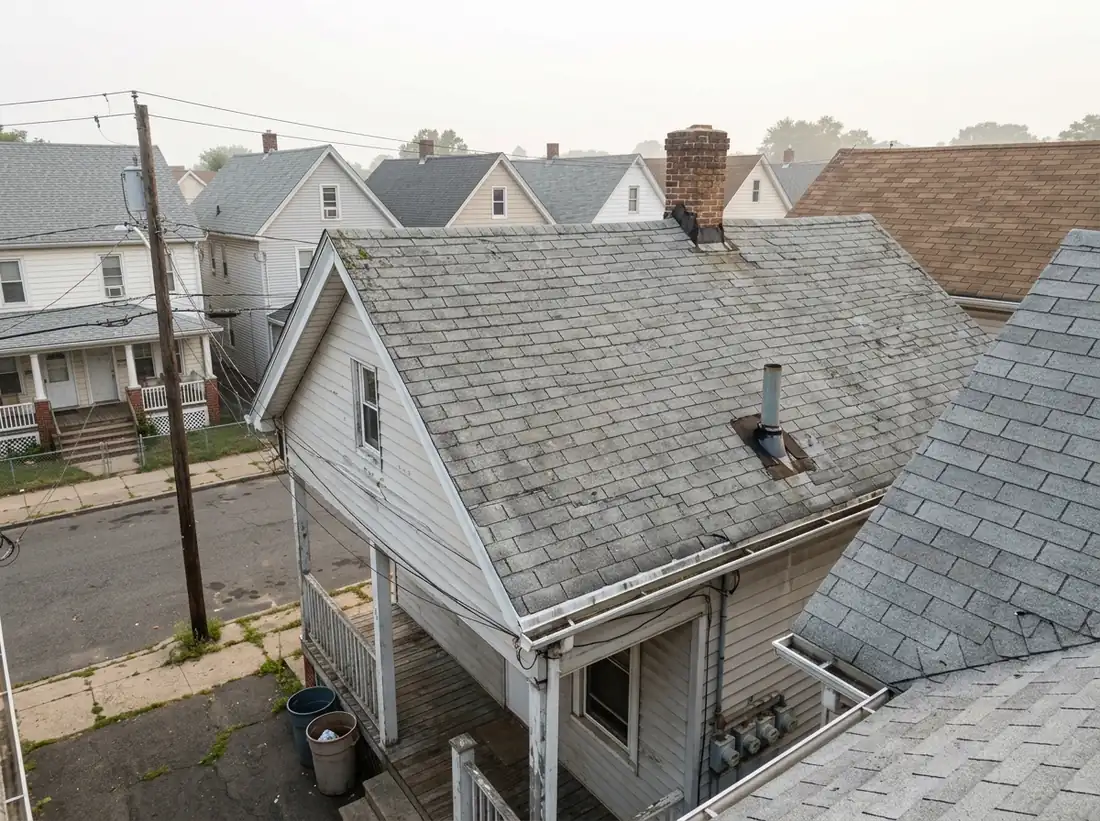
What are the signs you need roof repair?
You need a roofer when water is getting in or about to. These are the signs Elizabeth homeowners notice most, and what they usually point to:
| What you see | What it usually means |
|---|---|
| Brown ring-shaped stain on a ceiling | A slow leak above, often at flashing, a vent boot or a valley |
| Stain or peeling paint beside a chimney | Failed chimney flashing or a cracked chimney crown |
| Drips only in wind-driven rain | Water pushed under shingles or behind wall flashing at an edge |
| Leak only after snow | Ice dam at the eaves backing water under the shingles |
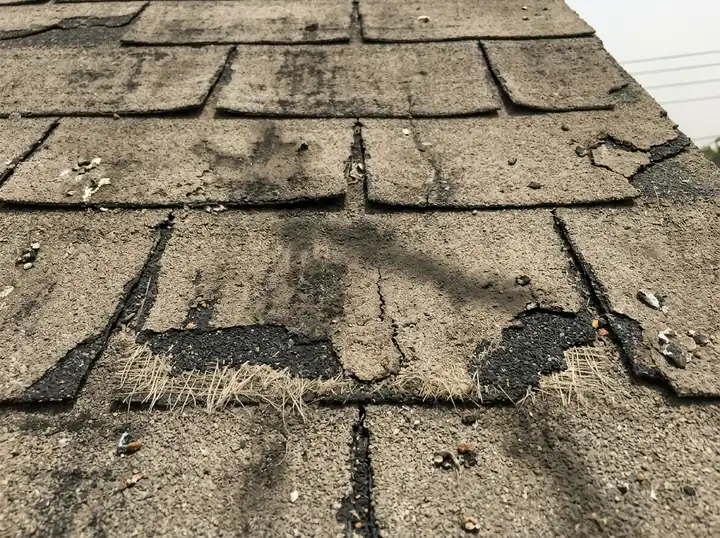
| Curling, cracked or missing shingles | Worn or wind-damaged shingles that no longer shed water |
| Shingle granules piling up in gutters | Shingles wearing out; the roof is aging |
| Ponding water on a flat roof two days after rain | Low spots or blocked drains stressing the membrane |
| Blisters, cracks or open seams on a flat roof | The membrane is failing; leaks often follow |
| Sagging roofline | Possible wet or rotted decking; have it checked soon |
| Musty attic, dark stains on roof boards | Long-running moisture and a mold risk |
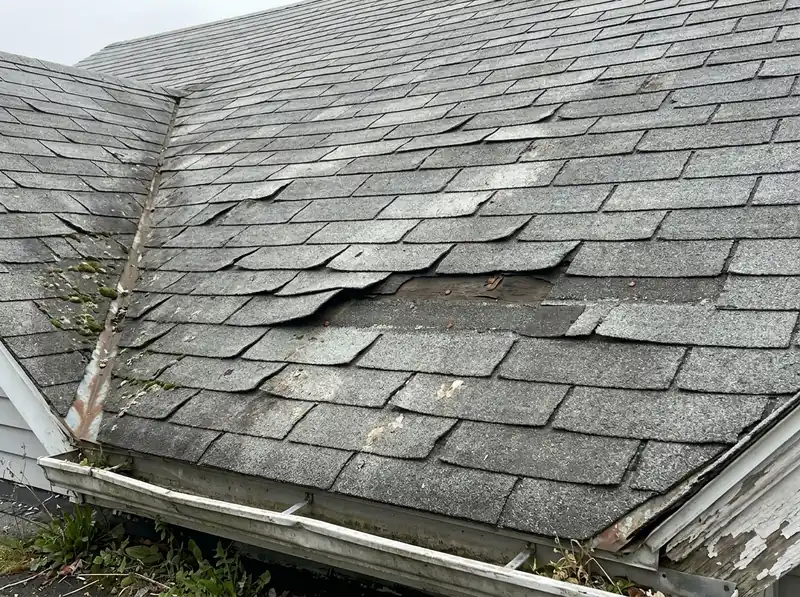
Curling and missing shingles
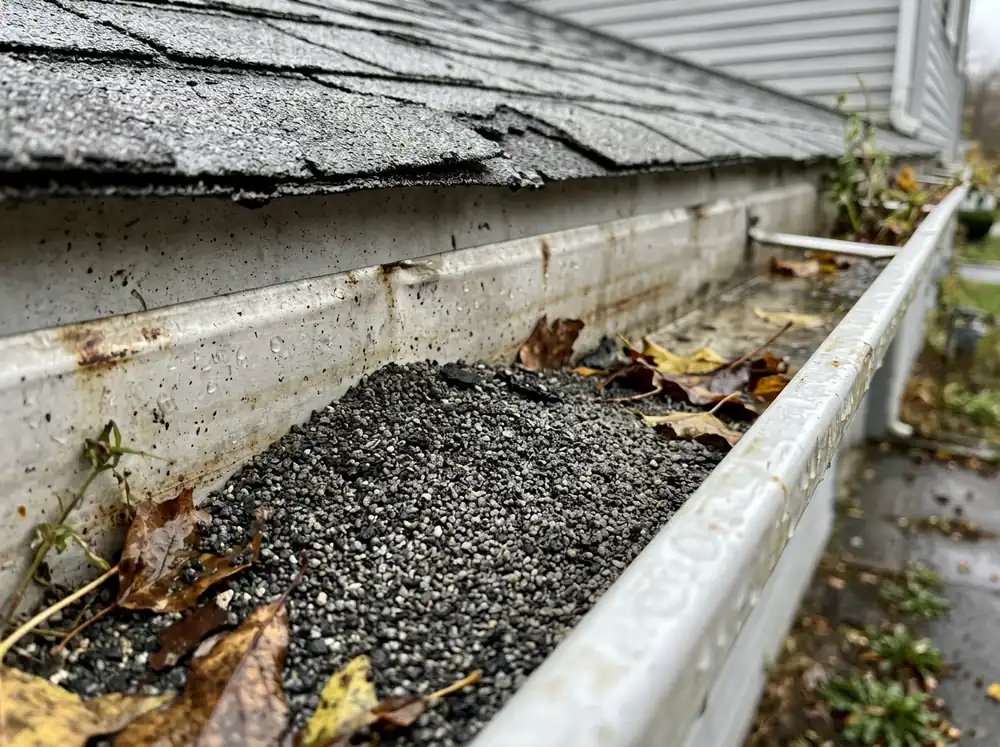
Granules in the gutter
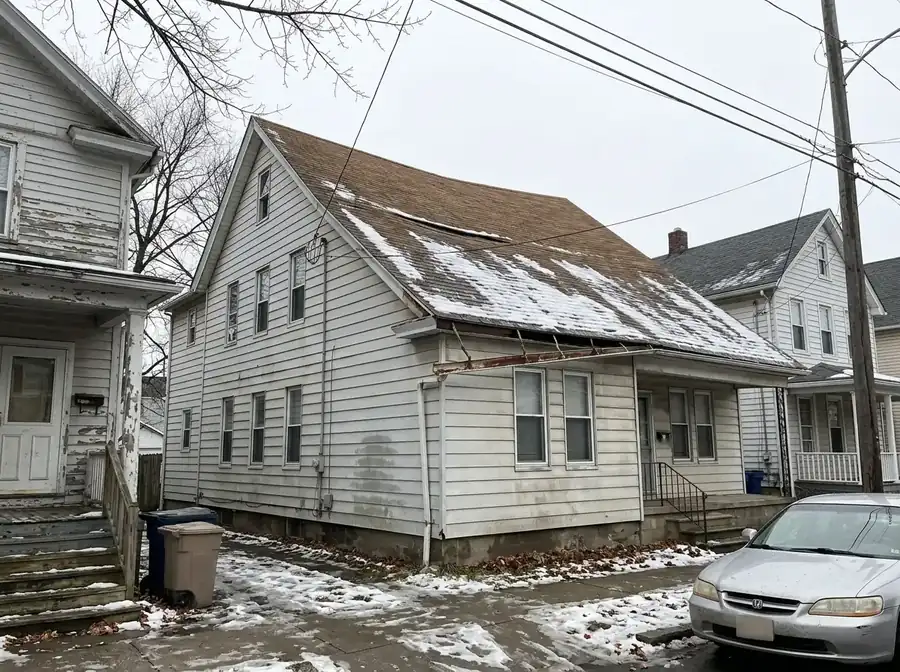
A sagging roofline
Can my roof be repaired, or do I need a new roof?
Most leaks can be repaired when the problem is in one spot and the rest of the roof is sound. A roof is usually near replacement when the problems are everywhere at once. A roofer has to see the roof to say for sure, but this is how the two usually compare:
| Repair usually makes sense when… | Replacement usually makes sense when… | |
|---|---|---|
| Where the problem is | One area: a flashing, a vent, a valley, a few shingles | Leaks or wear in several areas |
| Shingles | Mostly flat, intact, with granules | Curling, cracking, bald or brittle across the roof |
| Roof boards (decking) | Solid; any soft spot is small | Soft, sagging or rotted in several places |
| Past repairs | Few or none | Many patches; leaks keep coming back |
| Layers | One layer of shingles | Already two layers; another layer isn’t an option |
| Comparison | A targeted repair usually costs a small fraction of a new roof | Repeated patches can add up to more than they save |
Get two opinions if a roofer recommends a full replacement for one leak. When the whole roof is worn out, see roof replacement for what the job involves. Being upsold to a new roof is one of the most common worries NJ homeowners raise online, and a second look is normal and reasonable.
Should a 20-year-old roof be replaced?
Not automatically. Age alone doesn’t mean a roof has failed; condition does. Many asphalt shingle roofs in New Jersey wear out somewhere around the 20-year mark, so at that age it’s worth having a roofer check the shingles, flashing and decking. If the roof is mostly sound, targeted repairs can keep it working. Also check with your insurer: some now look harder at roofs around that age when renewing a policy.
Do you need a permit to repair a roof in Elizabeth, NJ?
Usually not for a detached one- or two-family home. Under the New Jersey Uniform Construction Code, repairing or replacing the roof covering on a detached one- or two-family dwelling is “ordinary maintenance” and does not need a construction permit (N.J.A.C. 5:23-2.7). Rowhouses and other attached homes, multi-family buildings, and any work on the roof’s structure can need a permit, so check with the City of Elizabeth’s construction office before that kind of work starts.
What is the 25% rule for roofing in New Jersey?
It’s an old rule that no longer applies to detached one- and two-family homes. Before March 5, 2018, New Jersey capped the amount of roofing that could be replaced without a permit at 25 percent. Since that date, any amount of roof covering repair or replacement on a detached one- or two-family home counts as ordinary maintenance. The “25% rule” you see online mostly comes from Florida’s building code.
Why does my flat roof leak every winter?
A flat roof that leaks every winter almost always has water getting into the membrane and freezing. It is not normal, even if someone tells you it is. Flat and low-slope roofs are common in Elizabeth on rowhouses, rear additions, porches and Midtown’s brick multi-family buildings, and they fail in a few predictable ways:
- Ponding water that sits more than about two days after rain, then freezes and expands.
- Open seams on rubber (EPDM) roofs, where the adhesive or tape lets go.
- Blisters and cracks in modified bitumen, especially under old silver coating.
- Clogged drains, scuppers or gutters that back water up into the edges.
- Coatings over failed roofs: a coating can’t seal a membrane that is already wet underneath.
Our flat roof repair page covers each of these for Elizabeth homes.
Why does my roof only leak when it’s windy and raining?
When a roof leaks only in wind-driven rain, water is being pushed sideways or upward into a gap that normal rain doesn’t reach. The usual spots are loose or missing shingles at the edges and ridge, gaps where the roof meets a wall or dormer (wall and step flashing), chimney flashing, and vents with cracked rubber boots. Nor’easters are when Elizabeth homeowners see this most. Note when and where it drips; that tells the roofer where to start looking.
Does homeowners insurance cover a roof leak in New Jersey?
It depends on why the roof leaked. Most NJ homeowners policies cover sudden damage, like a tree limb or a windstorm tearing off shingles, and the interior water damage it causes. They usually don’t cover leaks from age, wear and tear or poor maintenance. Check your policy for three things:
- Wind or hurricane deductible: some policies have a separate, higher deductible for wind damage.
- Actual cash value vs replacement cost: actual cash value pays less on an older roof because it subtracts depreciation.
- Time limits: report storm damage promptly and keep photos from before any repair.
My insurance company says my roof is too old. What can I do?
Ask your insurer in writing exactly what they need to see: a roof inspection report, proof of a recent repair, or a replacement. Some insurers now inspect roofs from the air with drones and send non-renewal notices based on roof age or condition. A written assessment from a roofer of the roof’s actual condition, with photos, is the document most insurers ask for. If the roof truly needs work, fixing the specific problems they listed can sometimes keep the policy.
My tenant reports a roof leak. What do I have to do as a landlord in NJ?
Act fast and keep a written record. New Jersey landlords must keep rental units fit to live in, and a leaking roof is a habitability problem. If a landlord doesn’t fix a serious defect within a reasonable time after written notice, NJ tenants can in some cases repair it and deduct the cost from rent, or withhold rent and raise the defect as a defense if the landlord takes them to court (Marini v. Ireland; NJ Department of Community Affairs guidance). This is general information, not legal advice. For an Elizabeth two-family, a leak in one unit is usually a leak in both, so it pays to fix it early.
Tenants: if your landlord won’t fix a leak, report it to them in writing and keep copies. You can also report it to the City of Elizabeth’s code enforcement office.
How do I check a roofer is legitimate in New Jersey?
Check their New Jersey Home Improvement Contractor (HIC) registration. New Jersey requires home improvement contractors, including roofers, to register with the NJ Division of Consumer Affairs, and you can look up any registration number on the Division’s website. Before you hire anyone, also:
- Get the agreement in writing, with the contractor’s legal name, address, HIC number, the work to be done, materials and start and finish dates.
- Know your right to cancel: under NJ law you can cancel a home improvement contract within three business days of signing.
- Ask for proof of liability insurance.
- Get a second opinion on any recommendation to replace the whole roof.
- Ask for photos of the problem area so you can see what they saw.
What are common roofing scam red flags in NJ?
- A door-knocker after a storm offering a “free roof” if you just pay your deductible. Waiving or covering an insurance deductible can be insurance fraud, and you sign the claim.
- “Zero down, no payments for 18 months” pressure to sign the same day.
- No HIC registration number, or a company name that changes every year.
- A large cash deposit before any work or materials.
- A roofer who finds a big problem but won’t show you photos of it.
What happens when you call Roof Repair Prime?
- You call (866) 413-3122.
- Tell us what’s happening: where the water shows up, what kind of roof you have, and whether it’s urgent.
- You’re connected with an independent local roofer who serves your part of Elizabeth.
- You and the roofer set up a visit to look at the roof.
- You decide. You’re never obligated to hire anyone you’re connected with.
Before you hire, ask for their NJ HIC registration number.
What kinds of roofs are on Elizabeth homes?
| Roof type | Where you see it in Elizabeth | Common problems |
|---|---|---|
| Asphalt shingle (pitched) | Most single- and two-family homes citywide | Wind-lifted shingles, worn granules, failed vent boots and valleys |
| Flat or low-slope (EPDM, modified bitumen) | Rowhouses, Midtown multi-family buildings, rear additions | Ponding water, open seams, blisters, clogged drains |
| Porch roofs | Two-families in Elmora and Peterstown | Low slope, leaf buildup, leaks where the porch roof meets the wall |
| Slate | Older Tudors and Colonials, especially in the North End | Broken or slipped slates, worn copper or metal flashing |
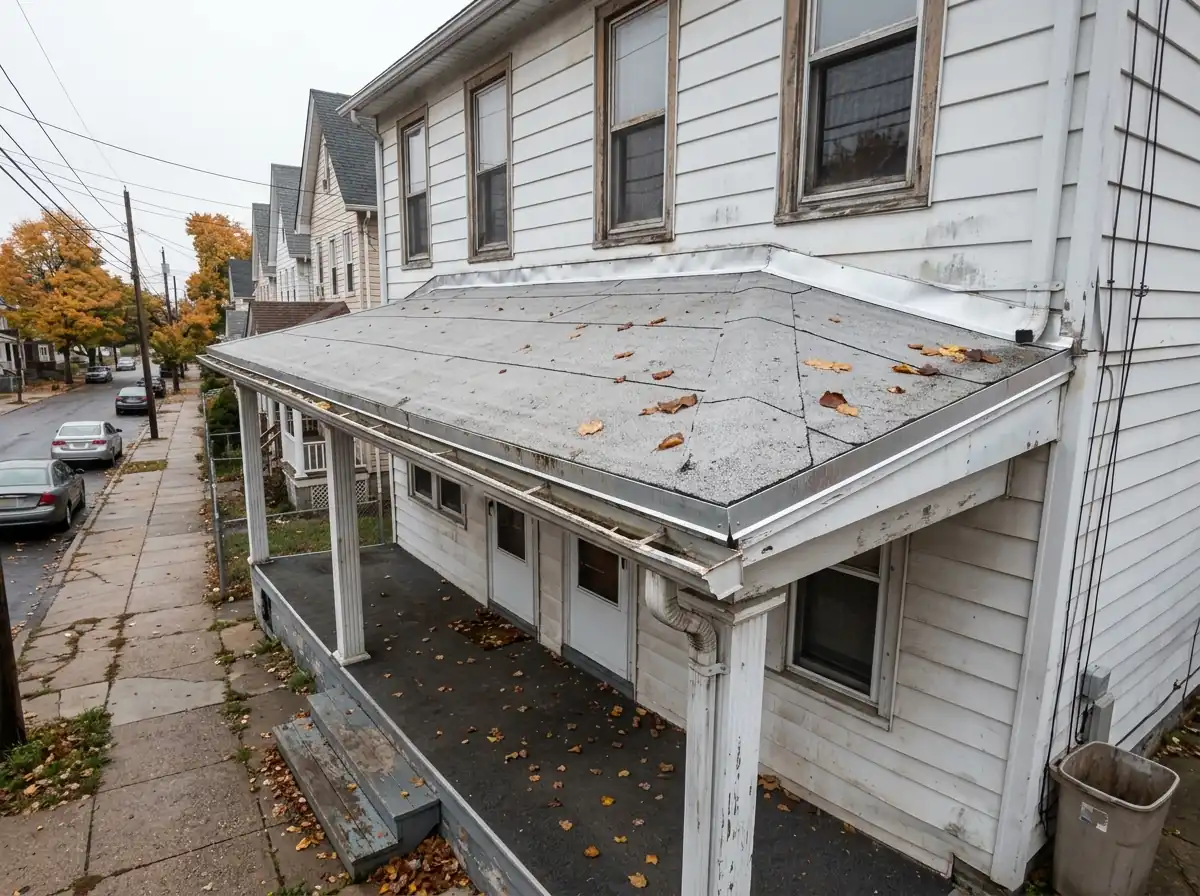
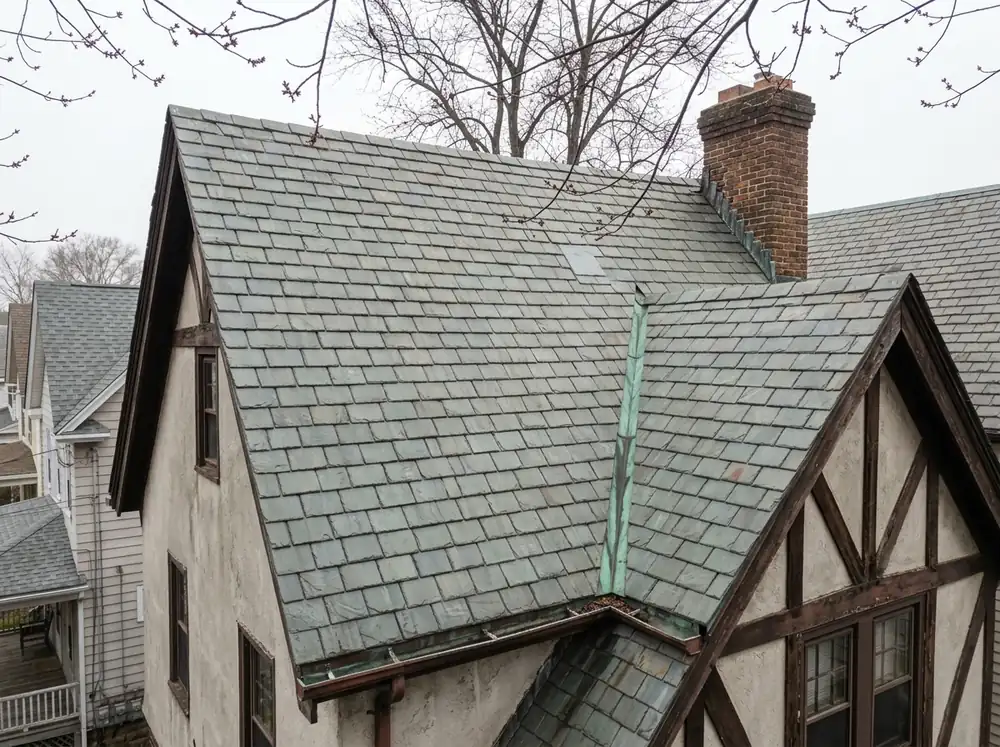
When is the best time to fix a roof in New Jersey?
The best time to fix a leak is as soon as you find it; the best time for planned roof work is late spring through early fall.
| Season | What happens to roofs | What to do |
|---|---|---|
| Winter (Dec–Feb) | Ice dams, freeze-thaw cracking, snow load on flat roofs | Clear gutters before freezes; call at the first ceiling stain |
| Spring (Mar–May) | Leaks from winter damage show up in spring rain | Have winter damage looked at early |
| Summer (Jun–Aug) | Heat ages shingles and coatings; thunderstorms hit clogged drains | Good season for planned repairs and flat roof work |
| Fall (Sep–Nov) | Leaves clog valleys and gutters; nor’easter season starts | Clean gutters and valleys; fix small problems before winter |
Who do we help?
Neighborhoods we serve in Elizabeth
Also serving Frog Hollow (see Elizabethport) and Keighry Head (see Midtown). ZIP codes 07201, 07202, 07206 and 07208.
Roof repair FAQ
How fast can a roofer come out for a leak?
It depends on the day, the weather and how busy local roofers are. Tell us on the call if water is coming in right now, so the roofer you’re connected with knows it’s urgent. After big storms, every roofer in the area gets busy at once, so call as early as you can.
Can you tell me what the repair will cost on the phone?
No. The cost depends on the roof type, how far the water has spread, whether the roof boards are damaged, and how hard the roof is to reach. A roofer needs to see the roof to give you a price.
Can I patch a roof leak myself?
You can protect the inside, catch water and take photos, but going on a wet, icy or steep roof is dangerous. Roof cement on the outside is a temporary fix at best; it often fails within a season and can hide where the leak really is.
Will a new roof stop a leak that’s coming from the chimney?
Not always. Many “roof” leaks come from chimney flashing, a cracked chimney crown, skylights or walls. If you replace the shingles but not the flashing, the leak can come right back. Ask the roofer where the water is actually getting in.
How long does a roof last in New Jersey?
It depends on the material and how well it was installed and ventilated. Asphalt shingles, the most common roof in Elizabeth, often last around 20 to 25 years; flat rubber and modified bitumen roofs often less; slate can last many decades if its flashing is maintained. Hard winters and nor’easters shorten those numbers.
Is Roof Repair Prime a roofing company?
No. We’re a free referral service. We connect Elizabeth homeowners with independent local roofers; the roofer you speak with does the inspection and the work.
Do you cover towns outside Elizabeth?
We’re starting with Elizabeth and adding nearby Union County towns like Linden, Union and Roselle next.
Updated October 2026 · Written by the Roof Repair Prime Editorial Team · Contact: info@roofrepairprime.com · Privacy Policy · Terms